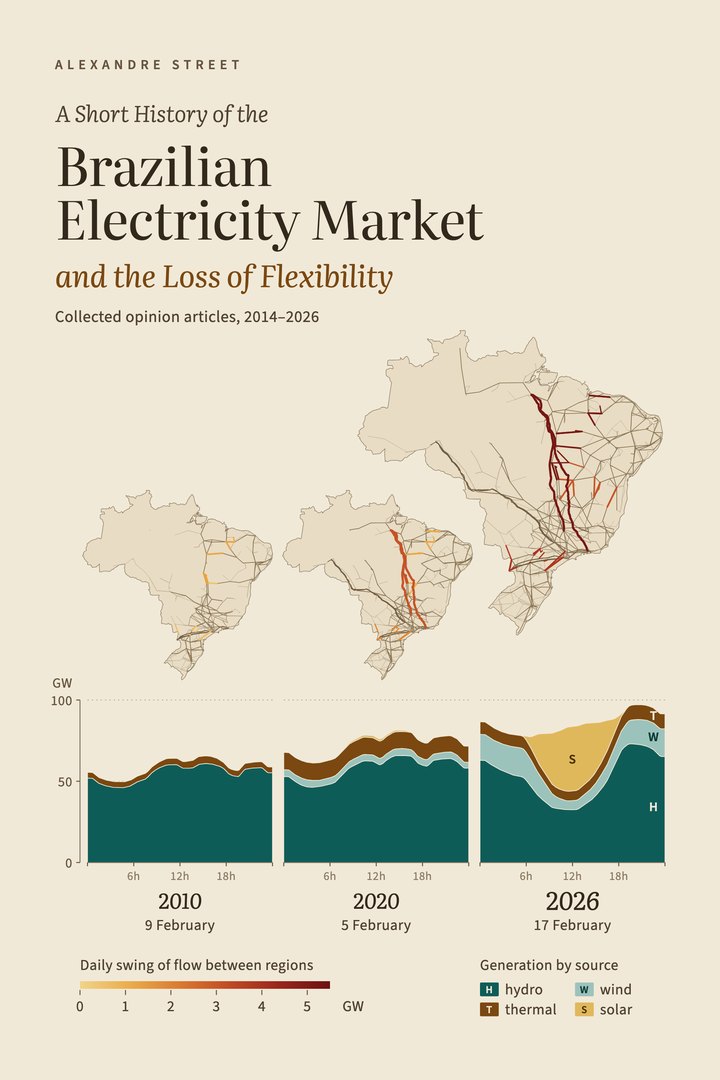
Electricity markets are unique because they are built on top of physical systems governed by the laws of physics, not by contracts or political will. Supply and demand must be balanced every second, power flows follow network constraints rather than contractual paths, and scarcity is shaped by time, location, and flexibility as much as by installed capacity. Market design must therefore acknowledge these physical realities and internalize what is truly scarce in order to communicate the right signals to agents. At the same time, electricity markets are also designed to address specific challenges and regional realities.
Because each country or state has its own climate and resource availability, as well as its own history, institutions, and political objectives, no two electricity markets in the world are the same. For this reason, there is no such thing as a single best market design. There are better designs and lessons learned. And because technologies, economies, political priorities, and even the climate itself evolve over time, adaptation is not a failure of market design but an intrinsic part of it. Notwithstanding, precisely because market design operates by shaping incentives, care must be taken when adding even small features or regulatory interventions, as seemingly minor changes can fundamentally alter incentives, distort price signals, and produce outcomes that diverge sharply from their original intent. This is particularly critical when dealing with subsidies.
Short-term prices form the cornerstone of electricity markets and create the link between all other instruments and the system scarcities. When prices internalize the system’s operational reality and reveal consumers’ willingness to pay as well as the scarcity of network resources and generation technologies required to keep the system in balance, the entire economic–technological circuit is activated to correct short-term shortage or surplus. In a market where prices reflect the “pain points” of operational reality, investors and entrepreneurs respond by directing capital, technology, and intelligence toward where economic value is highest.
This holds true even in markets largely based on long-term forward contracts, because deviations between contracted volumes and actual consumption, or generation, are settled against short-term spot prices. Short-term spot prices, therefore, guarantee the link between the long-term contract market and its incentives and the system’s short-term operational needs in the future. If this does not seem obvious to the reader, one need only ask renewable generators that have recently been curtailed, or, as I prefer to name, not dispatched. While their contract revenues remain unchanged, they have lost enormous sums due to the settlement, at short-term prices, of the differences between their actual generation and their contractual positions. Unfortunately, Brazil provides many examples of this effect, with several generation companies contracting up to their maximum regulatory limit (close to their average production), thereby disregarding the importance of considering both the feasibility and the captured price of their generation when setting long-term forward contract positions.
When the link between markets and operations is broken, operations will continue, but markets will no longer remunerate what is scarce or necessary. Especially in Latin American countries such as Brazil, but to some extent, it constitutes a big issue in any electricity market; this is the “root of all evil.” In a short time, the system operator will face an excess of what it does not need and a shortage of what is necessary. From there, we already know how the story unfolds and how things deteriorate: demands for more subsidies, special rules and auctions by technology type, judicial disputes, weakening of sectoral institutions, and regulatory capture by groups with strong political influence. All of this has, to some extent, been justified by the alleged inability of the market to efficiently attract or restrain investment, as well as by opportunistic narratives that dominate the debate by exploiting conjunctural side effects unrelated to the real causes of the system’s deterioration.
Moving from theory to the reality of the Brazilian electricity sector, the country has increasingly relied on intermittent renewable sources, such as wind and solar, following the halt in the construction of new reservoirs over the previous decade, as environmental constraints and stricter licensing requirements significantly limited the expansion of large hydro projects. Unlike other generation sources, solar and wind supply energy but consume system short-term flexibility due to the intermittent nature of their availability, something the current electricity market design in Brazil is still not prepared to handle.
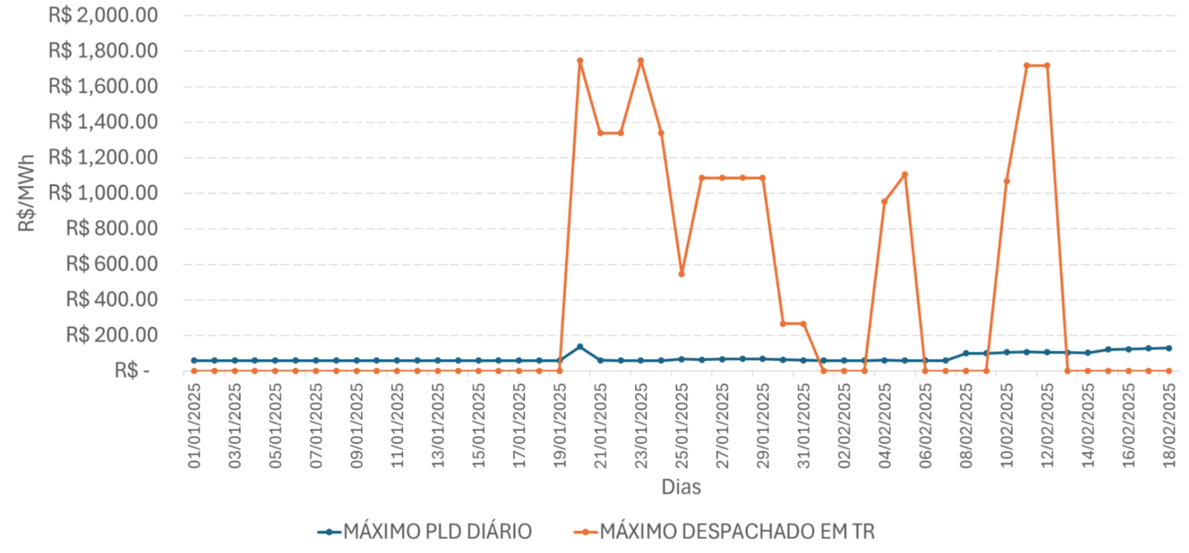
In addition to the absence of prices for ancillary services, the sectoral model sets wholesale short-term electricity prices one day in advance. As a result, all errors between what was forecast and what actually materializes from one day to the next, as well as most of the costs of the operational actions taken to correct them, are settled outside the market. This is clear in Figure 1, where spot prices, set one day earlier, significantly diverge from real-time reality.
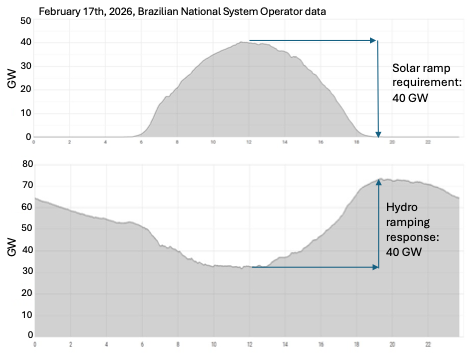
Under this design, agents that introduce uncertainty are not charged for the costs they impose, nor are those that help address it adequately remunerated. For example, as shown in Figure 2, on February 17, 2026, solar generation peaked at 40 GW around midday. At that time, hydroelectric generation was significantly reduced and later ramped up in the evening to compensate for the sharp drop in solar output at sunset. Despite its critical role in maintaining real-time system balance, this service, commonly referred to as flexibility, is not adequately valued in day-ahead spot prices, as many of the operational actions implemented in real time to manage the resulting net-load variation are not incorporated into the price formation process.
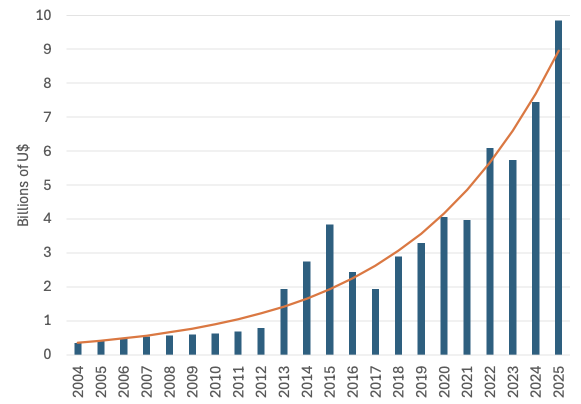
Added to these distortions is the dangerous shortcut adopted through subsidies to ensure that renewable sources could be deployed and thrive relative to conventional generation. Today, renewables receive three types of subsidies: (1) a 50% discount on transmission tariffs, (2) exemption from contributing to ancillary services, and (3) exemption from paying for the additional costs imposed by their uncertainty. This set of subsidies overlaps with short-term prices that have already been stripped of any scarcity signals arising from the inflexibility created by these sources. The result has been the emergence of a systematically inflated “perceived price” relative to competing generation technologies, fueling an accelerated subsidized expansion of wind and solar generation without the economic discipline that a well-designed market should impose. Figure 3 illustrates the exponential growth in subsidies passed on to consumers through tariffs in Brazil. The Energy Development Account (CDE), largely driven by subsidies for renewables, has grown at an average annual rate of 16.5%.
From 2022 onward, as the cost of subsidies allocated to residential consumers reached historically high levels, distributed generation (DG) was strongly boosted by an interpretation of the existing legal framework that allowed the sharing and selling, through a net-metering tariff, of energy produced by small solar farms within distribution networks. In this context, the DG challenged the status quo and the current market design by selling DG-energy credits within the regulated market, wherein commercialization was only allowed for the distribution company (a regulated monopolist retailer that competes in the wholesale market). So, this was a clear example of a new technology challenging the existing market design and regulation, which failed to properly adapt and internalize the new paradigm. As a consequence, the prevailing market design lost its capacity for self-regulation, as neither wholesale nor retail prices were reorganized to reflect the new technologies, and the variability and spatial distribution of generation and consumption resources that now shape short-term system operations.
It is in this environment, where short-term prices no longer represent the system’s operational reality, that competition ceases to operate in the interest of the system and consumers and instead becomes a competition for the next subsidy. It is also in this environment that economic and regulatory chaos takes hold, and lobbying power replaces market intelligence as the most effective strategy for winning the game. This is the state of Brazil’s electricity market at the end of 2025.
After the major electricity rationing crisis of 2001 in Brazil, the Revitalization Committee studied the main causes that led to the collapse and, based on solid technical analysis, laid the foundations for a new regulatory framework. At the heart of this new regulatory system were three main guidelines designed to secure clear long-term price signals to foster investment in new capacity in pace with the rapid demand growth experienced in developing economies:
- The first guideline stated that 100% of the load must be contracted. An ex-post penalty for under-contracting, together with a limit on cost pass-through for distribution companies, ensured incentives for timely contracting.
- The second guideline required that every contract be backed by an energy-reliability index, called the physical guarantee; an administratively calculated stamp, representing a probabilistic version of the firm energy certificates used for hydroelectric units.
- Finally, the third guideline limited distribution companies to purchasing standardized long-term contracts exclusively through public auctions, which, unlike in other Latin American countries such as Chile, were centrally organized by the Ministry of Mines and Energy as single-buyer procurement auctions.
While the first two guidelines ensured that there would be sufficient physical capacity to supply all consumption, the third secured a transparent and competitive systematic contracting scheme to distribution companies, which have the right to pass through on to consumers their purchase costs. Upon its implementation in 2004, the new regulatory design reconnected the load growth with the long-term investment signal, determined by equilibrium in the forward contract market. The result was a new cycle of robust and coordinated expansion that was followed by many countries in Latin America and seen as an interesting case all around the world.
Since 2004, many relevant aspects of power system operations in Latin America (LATAM) have changed, and most of the premises that formerly supported the selected approximations and market design are no longer valid. As a result, the current regulatory framework across LATAM faces numerous challenges. However, following the same logic that supported the 2000s reforms, the current challenges require a careful examination of their causes rather than a focus on their effects and consequences.
In this regard, for a long time, LATAM countries have downplayed the role of short-term spot prices due to the relative abundance of hydroelectric resources and their ability to “resolve” most short-term operational scarcities through their significant ramping capacity and inertia, attributes that confer high flexibility to these units. Now, with the massive integration of intermittent renewable resources, the lessons learned from countries that have been dealing with these issues for more than a decade become extremely valuable.
Thus, the structural solution to the current challenges faced in Brazil regarding the lack of flexibility is far more closely associated with (1) a gradual yet swift reduction of subsidies, (2) aligning spot prices with real-time system operation, (3) the creation of ancillary services markets, and (4) the development of new risk-management instruments and trading channels than with the proposed capacity auctions — a mechanism known to weaken scarcity pricing and distort investment incentives.
This reform agenda, however, does not stop at wholesale market reform. It also requires deeper integration between distribution system operators and the national system operator, as well as the development of the physical and regulatory foundations within the distribution segment necessary for consumers, aggregators, and distributed generators to participate actively in the market and respond to price signals.
These issues do not exhaust the menu of necessary improvements, but they point toward a more structural, self-regulating path, one that is less dependent on subsidies and market reserves than the one currently being pursued. The idea of paying for capacity solely to ensure that specific controllable sources remain in the game is not only a subsidy used to address the distortions created by another subsidy (for renewables), but also evidence that the current market design and regulatory framework (the rules of the game) have failed to foster what the system actually needs.
Therefore, the proposed capacity reserve auctions — characterized by (i) source-specific products, thereby reducing competition; (ii) static, single-attribute evaluation frameworks; (iii) the absence of clearing against short-term prices (unlike well-established call-option mechanisms already implemented in this country, these capacity contracts are completely disconnected from physical system conditions); and (iv) administratively defined demand, disconnected from the willingness to pay of those who ultimately bear the costs — do not address the structural problem. Instead, they merely add another layer of subsidies that will ultimately require correction.